U-value
The thermal transmittance coefficient, abbreviated U for unit of heat transfer (the unit of heat transfer), replaced the k-value in the course of European standardisation. Measuring the U-value determines the heat loss from the inside to the outside, specifically per square metre and per hour at a 1° temperature difference.
A window's thermal insulation depends on the frame material, the glazing and its airtightness. A window's insulating properties are determined by the U-value. The lower this figure, the better the thermal insulation.
For windows, three U-values are generally distinguished. The thermal transmittance coefficient Uw refers to the entire window. This value incorporates the U-values for the glazing Ug and the frame Uf.
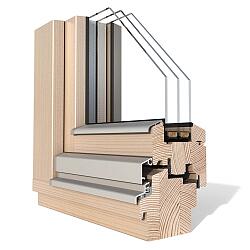
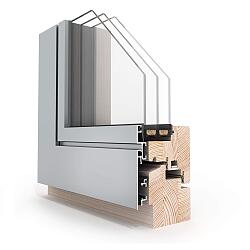
- Uf = U frame – is the U-value of the window frame.
The Uf-value is determined by measurement for the frame-and-sash combination. The visible width of the profile is taken as the area for calculating the Uw-value.
- Ug = U glazing – is the U-value of the glazing.
The Ug-value depends on the type of gas filling in the cavity between the panes, the distance between the panes and the number of panes.
- Uw = U window – is the U-value of the entire window.
The thermal transmittance coefficient for windows is generally calculated for the standard window size of 1.23 m x 1.48 m. Please note that larger glass areas achieve better values, since glazing allows better U-values than the frame material.
Under OIB Guideline 6 of 2011, the Uw-value for standard glazing must not exceed 1.4 W/m2K. The German Energy Saving Ordinance (EnEV) of 2014 limits the thermal transmittance coefficient to 1.3 W/m2K for an existing building. Windows with a Uw-value no greater than 0.8 W/m2K are considered suitable for passive houses.