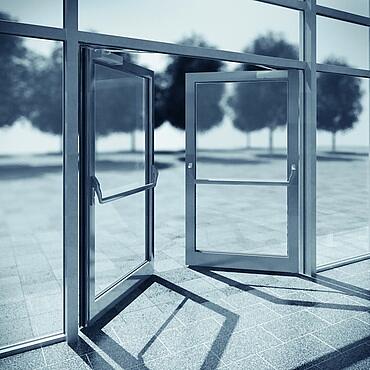
 The Europe-wide harmonisation of safety regulations in buildings of every kind has also given high priority to the planning of escape and rescue routes. This is why the standards EN 179 and EN 1125 have been specified for the hardware technology of panic and emergency exit doors. Above all, this means that the locking systems – comprising the hardware, the lock and further accessories – may only be labelled, tested and installed as a single unit. Schüco's emergency exit door systems comply precisely with these EN 179 and EN 1125 standards in their locking-system combinations. Finally, it should be noted that the EN 179 standard defines the requirements for locks and doors on escape and rescue routes in buildings. The EN 1125 standard, by contrast, is applied primarily in public buildings, for example in large shopping centres or at railway stations.
The likelihood of a panic
The various standards are based above all on the difference in how high the likelihood is that a panic breaks out. Particularly in public areas, where many unfamiliar people come together, the requirements for panic doors are governed by the EN 1125 standard. By contrast, in buildings that are not directly accessible to the public – such as an office or residential building with a manageable amount of visitor traffic – doors compliant with the EN 179 standard are used. In this way an orderly evacuation can be ensured.
What are anti-panic doors?
When a building has to be vacated quickly, the normal entrances and exits are usually not sufficient. For this reason escape routes are laid out in various parts of a building, and these have to be marked. However, so that these exits do not remain unlocked and open to anyone, anti-panic doors are used here. Should a particular situation arise in which the building has to be evacuated quickly, these doors can be used to get outside fast. For this purpose the door guards in accordance with EN 179 are fitted, for example, with a panic bar. During an escape through the door this bar is pressed downwards, thereby releasing the escape route. When it is used, an alarm is also triggered, which can be switched off again by an authorised person. If the door is used without reason, however, this is likewise indicated by this alarm. Doors compliant with the EN 1125 standard are used in a corresponding manner. In this case, though, a sticker draws attention to the fact that an alarm sounds if the door is opened without authorisation.
 Why are panic doors so important?
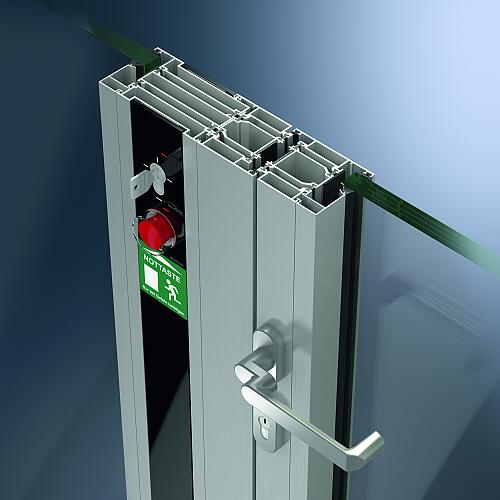
Every building, whether public or only partly public, needs more than just one exit so that, in the event of an emergency, everyone present on site can be quickly directed outside and thus to safety. Yet buildings do not need these many exits for normal visitor traffic; that would go beyond what is reasonable. For this reason the emergency exits are equipped with anti-panic doors, so that unauthorised entry from outside as well as from inside can be prevented. The larger and more complex a building is, however, the more exits it requires. This is already taken into account during the building's planning, since otherwise the building complex would not be approved by the responsible building authority on account of safety deficiencies.
Anti-panic doors can also be operated by people unfamiliar with the premises
Anti-panic doors in particular are manufactured in such a way that anyone can open these doors in an emergency, with an alarm indicating that the door has been opened. This means that if the door is opened without authorisation, the authorised persons are notified accordingly. It is important, however, that precisely in public buildings these doors can be opened by anyone without difficulty, as otherwise valuable time would be lost. The situation is different with the emergency exits that are used only in areas that are not open to the public. Here a person must be familiar with how to operate them, since otherwise the emergency exit door cannot be opened. Thus the difference between the DIN EN 179 and DIN EN 1125 standards lies above all in their operation and in their fields of application. Only these two standards are still approved across Europe for new installations.
 Our partner Schüco International, together with its hardware partner BKS, is the first company in Germany to demonstrate the necessary approvals and tests for hardware, lock and installation accessories, and can therefore provide a fully and completely equipped locking system for emergency exit and anti-panic doors.