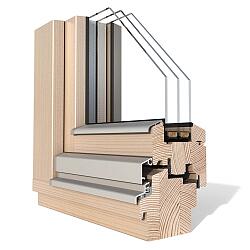
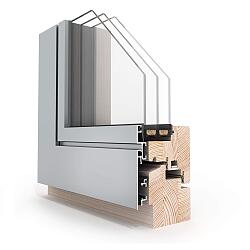
Stulp Window (False-Mullion Casement)
Multi-sash windows divide a large window area into individual sashes and can be implemented with various types of hardware. The window area can be subdivided either by a fixed central post (also known as a fixed mullion or transom) or by a loose false mullion (Stulp).
The Stulp (also referred to as a loose post) is the vertical profile strip on the false-mullion sash and, as an integral part of the window sash, opens together with the window. This creates an undivided window opening when the sash is open. When the false-mullion sash (also called the secondary sash) is closed, the Stulp profile serves as a rebate for the other sash.
A false-mullion window consists of two sashes joined in the centre. The main sash has a standard window handle, while the other has a hand lever (a release located in the frame).
The advantage of this window is that it can be opened "completely" without a central post remaining in place. False-mullion windows also provide a slim window construction and are particularly suitable for narrow window openings.
One disadvantage is that only the main sash of the window can be tilted. To open the secondary sash, you first have to open the main sash.
For wide windows (from approx. 150 cm), it is advisable to fit a post (transom) to improve the stability for the sashes to close against.