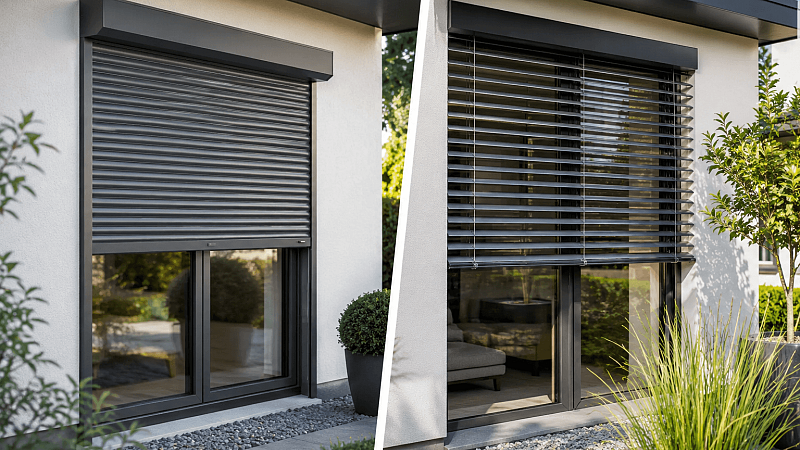
If you only think of blinds when it comes to sunny rooms, you are often missing valuable potential. Choosing the right types of sun protection for the home is not only about avoiding glare, but also about heat protection, privacy, operating comfort and ongoing energy costs. Especially in new construction or renovation, a careful comparison is worthwhile, because later retrofitting can look very different technically and financially compared with proper planning from the start.
Large window areas, patio doors and south- or west-facing façades quickly show one thing: not every sun protection system performs the same way. Some systems mainly block light, while others effectively reduce heat gain. Some solutions are attractive because of their low entry price, while others show their strengths through comfort, durability and better control. Anyone who wants to make an economical decision should therefore not only compare the purchase price, but also the intended use.
Sun protection types for the home - what really matters
The first basic question is: should the sun be stopped before it reaches the glass, or only once it is already inside the room? External sun protection usually has a clear advantage when it comes to summer heat protection, because the radiation does not even reach the glazing. Interior systems, on the other hand, are often cheaper, easier to retrofit and more flexible in terms of design, but they usually do not achieve the same effect against heat.
The location of the house is just as important. A north-facing side rarely needs maximum heat protection, while a large west-facing façade certainly does. Usage also matters: in the bedroom, blackout is more important; in the living room, privacy and light control are usually more important; in the home office, glare-free work at the screen is essential. A universally “best” sun protection system therefore does not exist. The right solution depends on orientation, window size, room use, budget and the desired level of operating comfort.
External sun protection types for the home
External systems are the first choice when heat protection is the priority. They work directly where the sun hits and are therefore especially suitable for large glass surfaces, modern façades and rooms with strong sun exposure.
Roller shutters
The roller shutter is the classic solution with a wide range of applications. It provides sun protection, blackout, privacy and, depending on the version, additional sound insulation as well as a noticeable security benefit. For bedrooms, children’s rooms and ground-floor windows, it is often the economically strongest all-round solution.
Its major advantage lies in its versatility. Roller shutters work just as well on single-family homes as they do in renovations and new construction. At the same time, the appearance is more closed than with more delicate systems, and when lowered, daylight is largely lost. Anyone who wants glare-free living during the day without darkening the room will often find a more refined solution in external Venetian blinds.
External Venetian blinds
External Venetian blinds are more technically and visually sophisticated. Their adjustable slats allow light to be controlled precisely. This is ideal for living areas, kitchens or offices where brightness is desired, but direct sunlight is disturbing. Especially on modern façades with large elements, external Venetian blinds are often the higher-quality answer.
Their advantage is the comfort of light regulation. Their disadvantage is that they are more sensitive to wind than roller shutters and are usually more cost-intensive. Anyone who frequently wants to adjust precisely between daylight, privacy and heat protection will benefit from them. Anyone who mainly wants robust blackout will usually find roller shutters simpler.
Screens and textile screens
Screens are external textile fabrics that reduce sun and glare without completely losing the connection to the outside. This makes them especially interesting for large window fronts, sliding doors and façades with a clean, modern line. Inside the room, they create a pleasant, filtered light effect.
Compared with roller shutters, screens are lighter and more discreet in design. However, they usually do not provide complete blackout and offer only limited additional benefit in terms of burglary resistance. For living areas where the view outside is important, they are often very strong. For bedrooms, they are usually less suitable.
Interior solutions - useful, but with limits
Interior sun protection scores mainly in terms of price, simple installation and design freedom. For rental properties, individual rooms or uncomplicated retrofitting, it is often the faster route. But when it comes to direct summer heat, the rule is clear: interior protection works less efficiently against heat than external systems.
Pleated blinds are popular because they are flexible, compact and available in many fabrics. They are suitable for standard windows as well as special shapes and can be finely adjusted for privacy and light transmission. Against strong heat build-up, however, they help only to a limited extent, even when coated fabrics are used.
Roller blinds and double roller blinds are a straightforward, attractively priced solution for glare and privacy protection. They are particularly suitable for bedrooms, bathrooms or workrooms. For design-oriented living spaces, vertical blinds are also often chosen, especially for floor-to-ceiling elements. The functional difference remains the same: light is regulated, but by that point the heat is already at the glass.
Which solution suits which house?
In new construction, sun protection should be considered early. This allows boxes, guide rails, power supply and façade appearance to be integrated cleanly. This not only looks more high-quality, but often also saves costs compared with later individual measures. Anyone who is already planning new windows, doors or large sliding elements is usually better served with a coordinated overall solution than with a patchwork approach.
In renovation, much depends on the existing structure. Not every façade allows the same installation methods, and not every budget can immediately cover the complete equipment of the whole house. In such cases, prioritization makes sense: first bedrooms and strongly sun-exposed living areas, then less critical façade sides. This keeps the investment manageable without saving in the wrong places.
For large south- and west-facing surfaces, roller shutters, external Venetian blinds or screens are usually the stronger candidates. For small windows, north-facing sides or rooms with low heat load, interior sun protection may be sufficient. This is exactly where good planning differs from a generic product choice.
Manual or electric?
For small quantities and low usage pressure, manual operation may be sufficient. The purchase cost is lower and the technology is simpler. In practice, however, it quickly becomes clear that sun protection is only used consistently when it is convenient to operate. Especially on several elements or hard-to-reach windows, motorized operation is often the more economical decision in the long term.
Electric systems offer more comfort and can be integrated better into everyday life. Time control, sun or wind sensors and central operation are not gimmicks; they increase the actual benefit. Anyone who is not at home during the day can still protect rooms from overheating. This is a real added value, especially with large-scale glazing.
Price, quality and custom-made solutions
When comparing prices, a sober look is worthwhile. A cheap standard system may seem attractive at first, but it does not always fit the dimensions, façade and usage requirements cleanly. Custom-made solutions are not automatically “expensive” to purchase; they are often simply more suitable. This reduces rework, visual compromises and functional losses.
System quality is another important factor. Guides, slats, fabric, drive and installation method together determine durability and everyday usability. Especially with sun protection that is moved every day, solid components pay off. Anyone who buys only according to the entry price may end up saving in the wrong place.
For many builders and renovators, transparent configuration is therefore essential. Dimensions, operating method, color and system type should be clearly comparable. A structured quotation process creates security here, because a rough idea becomes a reliable selection. This is exactly where direct sales offer a real advantage: individual custom production, a clear product structure and price advantages without unnecessary intermediate steps.
Common mistakes when choosing
The most common mistake is to see sun protection only as privacy protection. Anyone who wants to solve heat problems usually needs external systems. Another point is the wrong priority between design and function. A delicate appearance can be important, but it helps little if rooms overheat in summer or operation proves impractical in everyday life.
An imprecise assessment of the façade sides is also critical. Not every window needs the same solution. Anyone who plans the house in zones invests more strategically. Finally, motorization is often decided too late. What initially appears to be an extra is later often regretted as missing comfort.
Anyone who chooses sun protection types for the home correctly therefore thinks not only about the sun, but also about use, the building envelope and everyday life. The best solution is the one that fits permanently - technically, visually and economically. If you are equipping or modernizing your house, it is worth planning in a way that brings custom production, system quality and price advantage together directly. This way, you do not buy just any sun protection, but exactly the one tailored to your project.