The cheapest window quotation can quickly become expensive when measuring, sealing, removal or disposal are only charged once work begins on site. Anyone looking to compare window delivery and installation options should therefore consider more than just the final price. What matters is which services are actually included, who takes responsibility for measurements and installation joints, and whether the windows, installation and service are technically compatible.
With made-to-measure building components, there is no universal answer. Delivery without installation can be cost-effective when experienced tradespeople are already involved. For private renovators and homeowners, however, a coordinated complete package is often easier to budget for, especially when dealing with energy efficiency requirements, challenging window reveals or several different window and door sizes.
Compare Window Delivery and Installation: What Is Included?
Two quotations may specify identical window dimensions and similar profile systems while offering completely different scopes of work. One quotation may cover delivery to the kerbside only. Another may include measuring, delivery, professional installation, sealing and final inspection. Without a clear description of the services included, a reliable price comparison is therefore impossible.
First, check whether the quotation covers product delivery only, delivery with installation arranged through a third party, or a complete installation package. With a complete package, it should be clearly stated which partner will carry out the installation and who will remain your point of contact if corrective work becomes necessary later.
These Items Should Be Included in Every Comparable Quotation
A reliable quotation clearly separates product and installation costs and specifies the conditions required on site. Pay particular attention to the following points:
- Measurements taken before ordering and responsibility for the confirmed dimensions
- Delivery to the agreed unloading location, including vehicle access, floor level and carrying distances
- Removal of existing windows, transportation and disposal
- Fixing, insulation, and internal and external sealing of installation joints
- Installation of window sills, roller shutters, external venetian blinds, insect screens or door thresholds
- Final inspection, functional testing and arrangements for any outstanding work
If an item is missing, this does not automatically mean the quotation should be rejected. However, it must be identified either as an additional service with a specified price or as work to be provided by the customer. Particularly in older buildings, hidden damage to masonry, uneven window reveals or missing connections can create additional work. Reputable quotations do not downplay these risks but clearly explain how they will be handled.
The Product Price Is Only Part of the Total Cost
A window consists of more than just a frame and glass. The profile series, installation depth, glazing, hardware, colour, security features, ventilation and accessories all affect the price, weight and installation requirements. A large aluminium sliding element has different requirements from a standard PVC window. Comparing only prices per square metre therefore does not mean comparing equivalent products.
Start by comparing the technical specifications: material, profile system, opening type, glazing configuration, thermal insulation, sound insulation, security classification and visible features. Only once these specifications are comparable does it make sense to examine the installation price. High-quality systems from manufacturers such as Trocal, Schüco and Reynaers can only deliver their full benefits when the installation and connections are adapted to the specific window or door element.
The installation joint must also be included in the cost calculation. A window may offer excellent thermal insulation values and still lose unnecessary heat if the joint is incorrectly constructed. Different requirements apply to airtightness, thermal insulation and weather protection on the inside, within the insulation layer and on the outside. The appropriate solution depends on the wall construction, installation position and façade system.
Accurate Measurements Determine Costs and Responsibility
When configuring windows online, customers often enter the initial dimensions themselves. This is efficient and provides transparency during the quotation process. However, before production is definitively approved, it must be clear whether the measurements will be checked and who bears responsibility for any discrepancies.
With delivery-only orders, responsibility often lies with the customer or their appointed tradesperson. This can be a sensible arrangement when an architect, general contractor or experienced window installer has professionally measured and confirmed the openings. For homeowners without their own construction management, professional measuring before production approval is usually the safer option.
Ask specific questions: Are width and height measured at several points? Are the necessary installation gaps taken into account? Have existing window sills, roller shutter boxes, lintels and connection heights been checked? For balcony doors and front doors, finished floor levels, drainage and low-threshold access are also important. A low price without properly clarifying these details is not a saving but an unresolved financial risk.
Installation Quality Is About More Than Just a Promise
“Professional installation” sounds reassuring, but the term alone says very little. Ask about the specific fixing methods, the planned sealing system and the condition the window opening must be in before installation. Equally important is understanding which services are excluded. Plastering, painting, tiling and façade work are often not included in window installation, although they may become necessary after replacement.
In renovation projects, the existing installation conditions are crucial. Completely removing old frames involves different work from using a renovation system. Full removal can provide more daylight and better options for connecting the new windows to the building structure, but it often requires alterations to the window reveals and interior plaster. A solution that retains part of the existing frame may be quicker to install, but it can reduce the glazed area. The appropriate method depends on the building's condition, energy efficiency objectives and budget.
New buildings present different challenges. Is the wall opening complete? Have the sealing layers, façade insulation and construction schedules been coordinated with other trades? An installation partner needs this information before the scheduled installation date, not upon arrival at the construction site.
Order Delivery Separately or Combine It with Installation?
Ordering delivery and installation separately is particularly attractive when a reliable specialist contractor is already working on site. This gives you greater freedom when choosing an installer and allows you to schedule delivery and installation independently. However, you must also coordinate any complaints yourself. The supplier may attribute a problem to the installation, while the installer may point to the product or measurements.
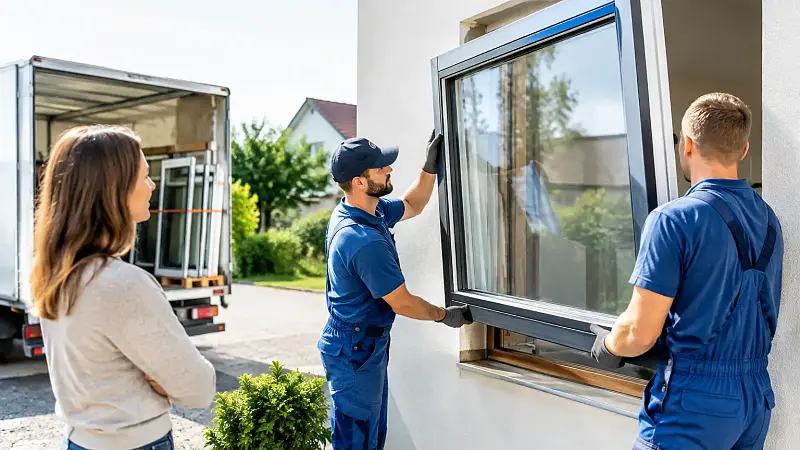
A combined package reduces these points of responsibility. Product configuration, made-to-measure manufacturing, measuring and installation are coordinated with one another. This does not necessarily make every individual service cheaper, but it can reduce planning time, additional charges and coordination errors. Having a single point of contact is a tangible advantage, particularly when dealing with several windows, lift-and-slide doors, front doors and solar shading systems.
A direct supplier offering configurable made-to-measure windows can demonstrate its strengths here. You can review the product specifications at an early stage, receive a non-binding quotation and adjust the features to suit your requirements. FENSTERNORM combines this direct relationship with manufacturers with measuring and installation options. This keeps pricing transparent without treating product quality and installation as two separate concerns.
How to Compare Total Costs Correctly
Place quotations side by side and examine not only the total amount but also the assumptions behind it. Are the number of units, dimensions, opening directions and features identical? Is the glazing comparable? Have travel costs, scaffolding, cranes or special carrying requirements been included? With large window and door elements, logistics alone can have a significant impact on the price.
If anything is unclear, do not settle for a vague promise that “everything is included”. Instead, request written clarification. A good quotation specifies the scope of installation, the conditions to be provided on site, the scheduling process and how additional work will be handled. Also ask what happens in the event of transport damage, incorrect measurements or subsequent adjustment work. Windows and doors contain moving components, and readjustments may be appropriate as construction progresses or seasonal conditions change.
Pay attention to a realistic sequence of work. First come measuring and technical assessment, followed by final approval for manufacturing, then delivery and installation. Ordering made-to-measure windows before connection heights or wall constructions have been clarified rarely saves time.
The best comparison does not end with the lowest price. Choose the quotation that combines your preferred window system, a clearly defined scope of installation and transparent responsibilities. This turns an online price into a reliable solution for your building.