Anyone planning a new front door often faces the same question: Is solid standard equipment sufficient, or does a higher security class make sense? This is exactly where front door security classes are explained, because there are significant differences between basic protection and genuine burglary resistance in terms of construction, hardware, glazing and price.
For homeowners, renovators and price-conscious buyers, this means that not every front door needs the highest level of security. But every front door should suit the installation situation, the building and the level of risk. Understanding the different classes makes it easier to compare quotations accurately and invest where the added value can actually be measured.
Front door security classes explained - what does RC actually mean?
When security classes are mentioned in connection with front doors, this generally refers to so-called RC classes. RC stands for “Resistance Class”. This classification describes how effectively a building element can withstand an attempted break-in.
The important point is that the class does not refer to a single component such as the lock or cylinder. The complete element is always tested. This includes the door leaf, frame, locking system, hinges, glazing and the professional construction of the entire unit. A strong multi-point locking system alone does not make a front door RC-rated.
For private residential buildings, RC1N, RC2 and, in some cases, RC3 are particularly relevant. Higher classes are generally used for commercial properties or buildings with particularly high security requirements. For most detached houses and renovation projects, the realistic choice is between RC2 and RC3 - depending on location, accessibility and budget.
Which front door security classes are really relevant?
RC1N is the simplest burglary-resistant classification at the lower end of the scale. This class provides basic protection against physical force such as kicking, striking or simply pushing the door open. However, RC1N offers only very limited resistance against tools such as screwdrivers or crowbars. For freely accessible house entrances, this class is therefore usually not the first choice.
RC2 is the most commonly recommended standard for residential buildings. A door in this class is designed to resist an opportunistic burglar using simple tools such as a screwdriver, pliers or wedges. Since many break-in attempts take place quickly and with simple tools, RC2 offers many homeowners a sensible balance between security and cost.
RC3 goes one step further. This class is designed to provide longer resistance against a more targeted attack involving additional tools such as a second screwdriver or crowbar. This can be worthwhile for secluded properties, entrances that are difficult to see from the street or higher-value properties. The cost is higher, but in return you get a significantly stronger overall construction.
For normal residential buildings, RC4 to RC6 are generally excessive. The complexity, weight, installation requirements and price increase considerably at these levels. Anyone considering these classes should have a very specific security requirement rather than simply assuming that more is always better.
Front door security classes explained by component
A security class is achieved through engineering, not advertising. It starts with the door leaf, which must be stable enough to withstand pressure and levering attempts. The material alone is not the deciding factor. An aluminium front door can provide excellent security, as can a high-quality PVC or timber construction - provided the overall system is designed correctly.
The frame is equally important. Particularly with low-cost offers, too little attention is often paid to the fact that even the best door offers limited protection if the frame is too weak. Burglary resistance only works when the door leaf and frame are structurally designed to work together.
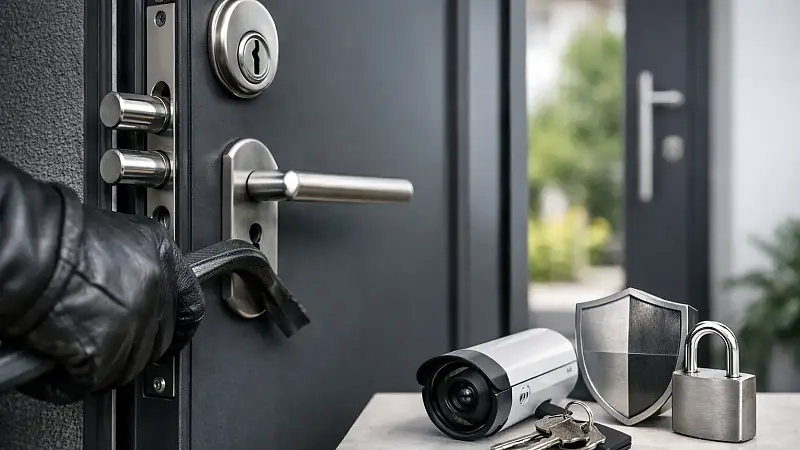
The locking system is another key element. Multi-point locking systems are practically essential for burglary-resistant front doors. They distribute the locking points along the height of the door and make levering significantly more difficult. This is complemented by robust strike plates, hinge-side security devices and a suitable profile cylinder with drilling and extraction protection.
As soon as glass is involved, careful planning becomes particularly important. Glass inserts, sidelights and transoms must correspond to the required security class. An RC2 door with unsuitable glazing or a weakly constructed sidelight compromises protection in exactly the wrong place. Especially with modern entrance doors featuring large glass areas, it is worth examining the technical specifications carefully.
Which RC class is right for which type of home?
For many new builds and modernisation projects, RC2 is the most economically sensible choice. This class covers typical residential security requirements well and provides a solid standard for most entrance situations. For a home in a normal residential area with an entrance that is clearly visible from outside, RC2 is often a very sensible choice.
RC3 becomes more relevant when the front door is barely visible from the street, the building is located on the edge of a residential area or longer periods of absence are common. RC3 can also make sense for high-value properties or mixed-use buildings. The additional cost is worthwhile where the risk is noticeably higher.
RC1N is more suitable when structural or budget constraints do not allow a higher class but a certain level of basic protection is still desired. In many cases, however, it is wiser to choose RC2 directly. The difference in practical benefit is often greater than it may appear on paper.
It is therefore not only the class itself that matters, but the overall security concept. A well-lit entrance, high-quality hardware, good visibility from outside and professional installation can often make a greater difference in everyday use than simply moving up to the next security class.
The most common mistake: focusing only on the door leaf
In practice, security classes are often viewed too narrowly. Buyers see a strong door leaf, a thick panel or a large lock and automatically assume a high level of security. This does not tell the whole story.
The weak point is often found in the details. An unprotected cylinder, weak hinges, unsuitable glazing or poor anchoring to the building structure can significantly reduce the benefits of a high-quality door. The situation becomes even more critical when sidelights or adjoining elements are visually coordinated with the door but technically provide a lower level of protection.
When comparing quotations, you should therefore always check whether the stated security class actually applies to the complete element. It is also important to know which features are included as standard and which are available only at an additional cost. This is precisely where a transparent configurator differs from unclear low-price offers.
How security classes really affect the price
Greater security costs money, but not every additional cost is expensive in relation to the benefit it provides. Upgrading from a basic standard door to a solid RC2 version is often money well spent. You not only gain additional protection, but usually also higher-quality hardware, better locking technology and a more robust overall construction.
The step from RC2 to RC3 depends much more on the individual situation. Material requirements, testing standards and construction details increase more significantly at this level. For some buildings this is absolutely worthwhile, while for others it may provide additional security without a meaningful benefit in everyday use.
Price-conscious buyers should therefore focus not only on the lowest starting price, but on the best balance between protection, features and service life. Made-to-measure production is particularly advantageous for front doors because only a precisely planned door can function properly from a technical perspective. Buying directly from the manufacturer can often provide significant price advantages without compromising system quality.
How to compare quotations correctly
A good quotation clearly and transparently states the security class. It should also specify which locking system is installed, how the cylinder and protective hardware are designed and whether any glazed areas correspond to the selected class. If this information is missing, caution is advisable.
Also consider whether the door is intended for a new build or a renovation. In older buildings, much depends on the existing wall structure and installation conditions. A strong door offers little benefit if the installation point itself has structural weaknesses. For this reason, honest professional advice should always take the surrounding construction into account.
For individually configurable front doors, a structured comparison is particularly worthwhile. By selecting dimensions, opening direction, material, glazing and security features according to your requirements, you receive a quotation that is technically suitable and clearly calculable in terms of price. This transparent approach is considerably more efficient when buying directly from the manufacturer than relying on a standardised quotation.
When additional features make sense
The RC class is the foundation, but it is not everything. A digital door viewer, motorised lock, fingerprint access or improved exterior lighting do not automatically increase the resistance class, but they can make everyday use safer and more convenient.
The same applies to the cylinder. A high-quality locking cylinder with a security card, extraction protection and drilling protection is not a minor detail, but part of a well-designed security concept. Saving money here often means saving in the wrong place.
Design does not have to come at the expense of security either. Modern front doors with clean lines, glass sections and high-quality finishes can now be combined very effectively with sensible burglary protection. What matters is not how solid the door looks, but how the system is technically constructed.
When planning a new front door, security should be neither underestimated nor overdimensioned. The better choice is usually the one that suits the property, has been properly tested and can be configured transparently. When comparing quotations, think in terms of complete systems rather than individual features - and you will ultimately buy not only an attractive door, but one that fulfils its purpose when it matters most.