Anyone renovating an older home quickly discovers that the front door is far more than a finishing touch. It plays a key role in thermal insulation, home security, sound reduction, and the overall appearance of the façade. Choosing the best front door for an older home is therefore not simply a matter of style. It is a careful balance of technical performance, precise dimensions, design, and budget.
Standard entrance doors rarely fit older properties perfectly. Existing wall openings often differ from modern dimensions, door reveals may be uneven, and architectural requirements such as historic façades, heritage regulations, or matching existing windows and sidelights must often be considered. Choosing too quickly can easily lead to costly alterations or ongoing energy loss.
Which Front Door Is Best for an Older Home?
The best entrance door is not automatically the most expensive one. The right choice depends entirely on the building itself. An unrenovated period property with thick masonry walls has very different requirements from an energy efficient townhouse that has already been modernised and requires higher levels of security or sound insulation.
In most renovation projects, four factors are essential: an appearance that complements the building, reliable thermal insulation, effective security, and precise custom manufacturing. The last point is often underestimated. A front door must not only look attractive but also fit perfectly into the existing opening. If the clearances, connections, or threshold are incorrect, even excellent insulation values on paper will not deliver the expected results.
The Best Front Doors for Older Homes by Material
Material selection is where appearance and performance meet. Timber, aluminium, and PVC each offer distinct advantages as well as certain limitations.
Timber Front Doors for Older Homes
Timber often provides the most authentic appearance for period properties. Whether restoring a traditional townhouse, a historic façade, or a classic entrance, a timber door usually blends more naturally with the architecture than an ultra modern alternative. It also offers a premium feel and exceptional flexibility when choosing panel designs, profiles, colours, and decorative details.
The main disadvantages are the higher purchase price and the ongoing maintenance requirements. High quality timber entrance doors are a long term investment and, depending on the finish, require periodic care. For homeowners seeking a traditional appearance with timeless character, timber often remains the ideal choice.
Aluminium Doors for Modern Renovations
Aluminium entrance doors are an excellent option for homeowners looking to combine contemporary design, structural strength, and minimal maintenance. The material is exceptionally stable, durable, and technically advanced, making it ideal for large door panels, sidelights, and high security configurations.
Aluminium performs remarkably well in older buildings, often better than many people expect. Not every aluminium door has to look ultra modern. With carefully chosen colours, elegant proportions, or classic panel layouts, aluminium can complement traditional architecture beautifully. Especially when the façade has already been renovated, it frequently offers the strongest combination of value, durability, and long term performance.
PVC Entrance Doors for Budget Conscious Renovations
PVC entrance doors are an attractive solution when keeping costs under control is a priority while still achieving solid technical performance. High quality PVC entrance doors provide good thermal insulation, low maintenance, and reliable everyday durability. They are particularly suitable for straightforward renovations, rental properties, or secondary entrances where practicality is more important than architectural prestige.
However, material selection should always match the building. At the main entrance of a high quality period property, PVC may not always create the desired visual impact. Likewise, very large door panels or demanding architectural designs may exceed the practical limits of the material. PVC offers excellent value, but it is not necessarily the best choice for every installation.
Thermal Insulation: More Than Just U Values
Many buyers naturally focus on the U value first. While this is an important indicator, it never tells the complete story in older buildings. Even the most highly insulated entrance door cannot perform properly if the installation joints, threshold, or wall connections are poorly executed.
More important than brochure values is the way the complete system works together. The door leaf, frame, sealing system, glazing, and installation quality all contribute to the final performance. Especially in older properties with uneven wall openings, the entrance door should always be considered as a complete system. Homeowners replacing a front door to reduce heating costs should therefore evaluate not only the product itself but also the installation method and connection details.
Security Matters More Than Ever in Older Homes
Many older properties still have original entrance doors with outdated locking systems, lightweight door panels, or weak frames. These are often the first points targeted during burglary attempts. Replacing the entrance door is therefore an excellent opportunity not only to improve appearance but also to significantly increase the security of your home.
Modern entrance doors should include multipoint locking systems, robust hinges, high security cylinders, and a solid overall construction. Where glazed panels or sidelights are part of the design, laminated safety glass is also worth considering. The appropriate resistance class depends on the type of property. A detached house often requires a different level of protection from an apartment building with a secure communal entrance.
As with every renovation decision, balance is important. Not every older property requires the highest available security specification. However, investing in a new entrance door without upgrading to modern security standards is rarely a wise long term decision.
Matching the Door to the Character of the Building
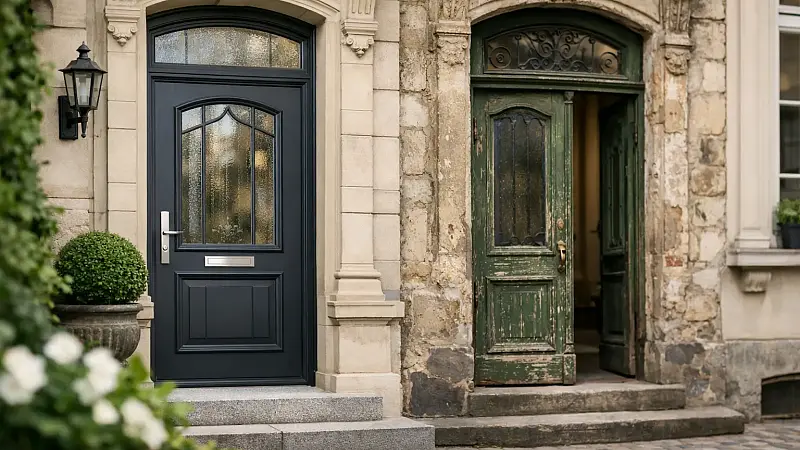
The best entrance door for an older home should complement the architecture rather than compete with it. Although smooth anthracite door panels may look impressive in a brochure, they can appear out of place on a historic façade. Likewise, an overly decorative panel door may feel outdated on a carefully modernised building.
The overall composition is what matters most. Window proportions, colour, hardware, glazing, and panel details should all reflect the architectural character of the property. For buildings with strong historical identity, the most successful entrance door is usually the one that blends naturally into the façade rather than attracting attention through excessive design.
When Heritage Regulations Apply
If the building is protected by heritage regulations, the available design options may be more limited. Visible frame widths, traditional panel layouts, colours, glazing divisions, and surface finishes often need to follow specific architectural guidelines. In these situations, custom manufacturing is not a luxury but an essential requirement. At the same time, the door should still provide modern levels of insulation, security, and everyday performance.
Why Custom Manufacturing Is the Better Solution
Standard door sizes rarely fit older properties perfectly. Uneven wall openings, unusual dimensions, varying wall thicknesses, or existing sidelights often make a custom made entrance door the most practical and economical solution.
Custom manufacturing should not be seen as a premium extra. In many renovation projects, it is simply the most cost effective approach. Every adjustment carried out on site increases installation time, labour costs, and the risk of imperfect sealing or visual defects. A door that is manufactured to the exact dimensions of the building provides a cleaner installation and a far better long term result.
Buying directly from the manufacturer makes this process even more efficient. When dimensions, opening direction, colours, glazing options, and security features can all be configured clearly from the beginning, buyers receive a transparent quotation and can compare different solutions far more easily than by moving from one standard showroom model to another.
How to Compare Front Doors for an Older Home
When reviewing quotations, it is important to look beyond the material or the starting price. The complete specification should include the construction of the door leaf, profile quality, sealing system, locking mechanism, glazing, threshold design, colour options, and any custom dimensions required.
The quality of the profile system is equally important. Two entrance doors may look almost identical while offering very different levels of strength, thermal insulation, ease of operation, and long term durability. Buyers who want to compare price and performance fairly should therefore insist on transparent specifications. This is exactly where a clearly structured quotation process, such as the one offered by FENSTERNORM for custom made entrance doors, provides a significant advantage.
Which Entrance Door Is Ultimately the Right Choice?
For traditional period homes with a strong architectural character, timber often remains the preferred choice. Its authentic appearance, premium craftsmanship, and ability to match historic façades make it particularly attractive for homeowners who value timeless design.
For many energy efficient renovation projects, aluminium offers the strongest overall solution. It combines outstanding durability, modern security, excellent thermal performance, and minimal maintenance. Homeowners looking for a long lasting investment with contemporary performance often find aluminium to be the ideal balance between functionality and design.
PVC entrance doors are an excellent option whenever affordability is the priority. They provide reliable insulation, low maintenance, and excellent value for money, making them especially suitable for straightforward renovations, secondary entrances, or projects where the budget needs to be carefully controlled.
Ultimately, however, the right decision is not determined by the material alone. It depends on finding the best combination of appearance, installation requirements, security, thermal performance, and budget. That is why an entrance door for an older home should always be selected as a custom made solution based on accurate measurements, transparent technical specifications, and a quotation that allows meaningful comparisons.
When your new entrance door complements the character of the building, closes perfectly, improves energy efficiency, enhances security, and continues to perform reliably year after year, it becomes much more than a replacement. It becomes a long term investment that adds value and comfort every single day.