Anyone planning, renovating or modernizing a terrace quickly notices: a patio door types overview is not just about appearance. It is about opening type, space requirements, thermal insulation, ease of operation, security and ultimately also price. This is exactly where typical wrong decisions happen, for example when a large glass area is desired, but the selected door type offers too little passage width or becomes impractical in everyday use.
The good news: anyone who compares the most important systems carefully can make a very targeted choice. For a single-family house, an extension, a conservatory or a commercial project, there is not one single best solution, but the right door type for the respective use. Custom production, profile quality and the right equipment are just as important as the basic system itself.
Patio door types overview: which systems are available?
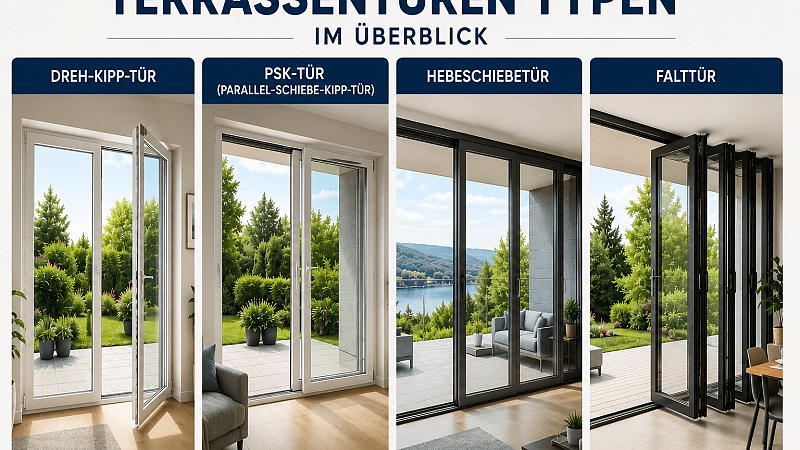
At their core, patio doors differ by the way they open. That may sound simple, but it affects almost everything - from furniture placement to the threshold. The most common types are tilt-and-turn doors, PSK doors, lift-and-slide doors and folding doors. Fixed glazing in combination with opening elements is also common, which is often economically sensible for wide façades.
The classic tilt-and-turn door is familiar to many people from balcony doors. It opens inward and can also be tilted. The system is proven, comparatively attractive in price and technically uncomplicated. For smaller to medium-sized openings, it is often the most economical solution.
The PSK door - parallel sliding and tilt door - slides the sash sideways after it has been released from the sealing plane. It saves swing space inside and offers more glass area than a pure tilt-and-turn solution. In everyday use, however, it is mechanically more demanding and not as comfortable as a lift-and-slide door for very large elements.
The lift-and-slide door is especially popular in high-quality residential construction and for large openings. When opened, the sash is lifted slightly and then moves smoothly to the side. This allows wide passages, slim lines and a premium appearance. At the same time, this system is usually priced above classic door solutions.
The folding door consists of several elements that fold to the side like a package. If maximum opening width is desired, it has clear advantages. In return, the proportion of profiles, fittings and planning effort is higher. Here too, the rule applies: strong in effect, but not the first choice for every budget.
The classic tilt-and-turn patio door
When value for money is the main focus, the tilt-and-turn door is often the first candidate. It is especially suitable for standard openings, renovations and homeowners looking for a solid, tightly closing and easy-to-operate solution. With one- or two-sash versions, many living situations can be covered economically.
Its disadvantage lies in the swing area. The sash opens into the room, which can quickly become disturbing with tight furniture arrangements. Anyone planning a dining table, sofa or kitchen island directly in front of the door should consider this early. With larger glass formats, the sash weight also increases, which creates limits.
Technically, this type convinces with good tightness, solid thermal insulation values and a wide range of security and glazing options. In PVC, wood, wood-aluminum or aluminum, the system can be adapted well to the façade and budget.
PSK doors as a space-saving intermediate solution
In a patio door types overview, the PSK door is often chosen as a compromise between a classic door and a sliding door. It is interesting when a sliding function is desired, but the budget should remain below that of a lift-and-slide door. This can be particularly useful in renovations.
The advantage is the lower space requirement inside the room. The sash does not swing fully into the interior, but is unlocked for opening and then guided sideways. This creates more freedom in furnishing and looks more modern than a pure hinged door.
The PSK door is less strong when it comes to the operating comfort of large elements. It works reliably, but requires a little more mechanics and usually also a little more attention during operation. Anyone who wants to use wide openings comfortably every day is often better served with a lift-and-slide door.
Lift-and-slide doors for large glass areas
When light, openness and a high-quality transition to the terrace are the focus, there is often no way around the lift-and-slide door. It is the strong solution for large widths, generous living areas and modern architecture. The passage is wide, the threshold can be planned low, and even heavy sashes can be moved comfortably.
This system especially shows its strengths in new construction and high-quality renovation. Large glass areas increase the amount of daylight, and the living space feels more open. In combination with high-performance profiles from brand manufacturers, good thermal insulation and security values can also be achieved with large formats.
The decisive point is the budget. Lift-and-slide doors are more complex in construction and are clearly priced above standard solutions. In return, however, you also get real added value in comfort, appearance and use. Anyone who plans long-term and uses the transition to the outside intensively often invests in the right place here.
Folding doors for maximum opening
Folding doors are not a mass-market product, but they are highly interesting for certain building projects. If the entire front to the garden is to be opened, this system is hard to beat. The individual sashes fold together to the side, creating very wide openings.
This is ideal for summer areas, exclusive living concepts, conservatories or hospitality and commercial solutions. In private house construction, however, it should be carefully considered whether the maximum opening is really needed in everyday life. The technical and financial effort is higher, and the profile division is more noticeable than with large sliding elements.
Folding doors are therefore a special solution with a strong effect, but not automatically the most sensible standard choice. Anyone mainly looking for light, insulation and convenient operation more often ends up with the lift-and-slide door.
Which material suits which door type?
Not only the door type, but also the frame material shapes price, appearance and performance. PVC is usually the most economical choice. The material offers good insulation values, is easy to maintain and is particularly attractive when a solid price-performance ratio is required.
Aluminum looks slim and modern and is structurally very interesting for large elements. Especially with lift-and-slide doors and wide glass areas, it plays to its strengths. In return, aluminum is generally higher in price, but also offers a premium architectural appearance.
Wood creates a warm, natural impression and scores with a comfortable living atmosphere. Wood-aluminum combines the interior character of wood with a weather-resistant outer shell. These solutions are high-quality, but usually not the cheapest. Anyone with a strong focus on budget should therefore compare not only the door type, but also the material class.
What really matters when choosing
The right patio door is not decided by a single feature. The decisive factors are opening width, usage habits, space in front of and behind the door, energy requirements and the desired appearance. Anyone who only looks at the entry price often buys too small or misses the actual need. Anyone who only looks at design may end up paying for functions that are hardly used in everyday life.
For smaller openings and a clear budget limit, the tilt-and-turn door is often the sensible solution. If more glass and less swing space are required, a PSK door can be suitable. For large openings, high comfort and modern architecture, the lift-and-slide door is usually the strongest choice. Folding doors are worthwhile where maximum opening is a real usage criterion.
The right configuration is also important. Glazing, security fittings, threshold solution, handle equipment, color choice and sun protection should be considered early. Especially with custom-made elements, a clean comparison pays off because comfort and price can be controlled in a targeted way.
Understanding price differences correctly
Many buyers first ask for the cheapest system. This is understandable, but it does not go far enough. A cheaper door may feel more expensive in the end if it is inconvenient in everyday use, offers less opening width or performs worse energetically. Conversely, the most expensive solution is not automatically the best if the opening is small and the added value is hardly used.
The decisive factor is to view the price in relation to the use. A lift-and-slide door costs more, but with large living openings it also delivers visibly more comfort and effect. A classic door is cheaper and technically solid when it fits the application. This is exactly why direct comparison by dimensions, material and equipment is worthwhile instead of relying on rough standard prices.
Anyone who configures online and compares offers transparently saves not only time, but often money as well. Custom-made solutions calculated directly by the manufacturer create significantly more clarity than general estimates.
Which patio door makes sense for whom?
For renovators with standard dimensions and a clear price limit, the tilt-and-turn door is usually the most economical choice. For homeowners looking for a modern sliding solution but not wanting to enter the upper price segment, the PSK door can be interesting. For new buildings, high-quality renovations and wide façades, the lift-and-slide door is in many cases the most convincing solution. And for projects with a maximum opening requirement, the folding door is the suitable special variant.
At FENSTERNORM, exactly this comparison is at the center: custom production, strong profile systems, a clear product structure and a quotation process that makes selection and price transparent. This turns a wide variety of systems from uncertainty into a clean decision.
In the end, what matters is not which door type looks most spectacular on paper, but which one really works in your floor plan, your budget and your everyday life - exactly there is where good planning separates itself from expensive compromises.